Development
Worker design
Context level
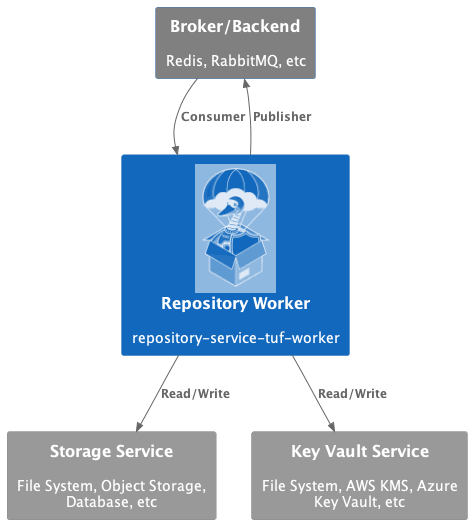
The repository-service-tuf-worker, in the context perspective, is a Consumer and
Publisher from the Broker that receives tasks to perform in the
TUF Metadata Repository. The Metadata Repository is stored using a
Repository Storage Service that reads/writes this data. For signing some of
the Metadata, the repository-service-tuf-worker uses the online key.
Container level
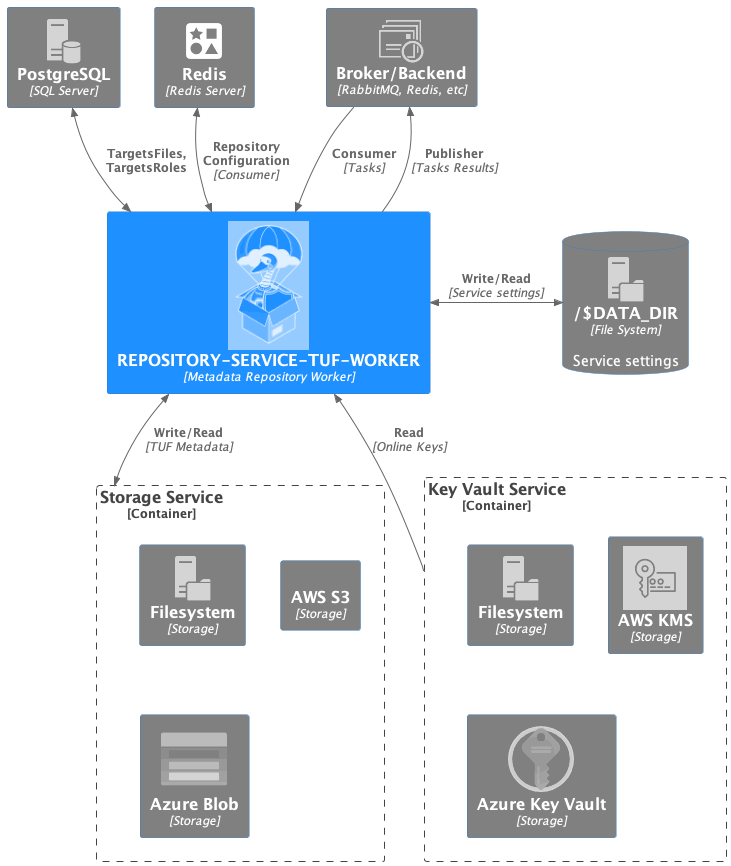
The repository-service-tuf-worker, in the container perspective, is a Metadata
Repository worker that performs actions to the TUF Metadata.
It will consume tasks from the Broker server and execute the task actions in
the Metadata Repository using the Storage Service to handle the TUF
Metadata. After executing any task, repository-service-tuf-api publishes to
the Broker.
The repository-service-tuf-worker implements the service Storage Service.
- Current supported Storage Services types:
LocalStorage (File System)
S3Storage (AWS S3 Object Storage – to be implemented)
The repository-service-tuf-worker stores configuration settings. These are the
Worker Settings.
The repository-service-tuf-worker``also uses the **Repository Settings**, from
``RSTUF_REDIS_SERVER.
Worker Settings: are related to the operational configurations to run the
repository-service-tuf-worker such as worker id, Broker, type of Storage, Key
Vault services and their sub-configurations, etc.
Repository Settings are given by repository-service-tuf-api and
are stored in RSTUF_REDIS_SERVER to run routine tasks such as bumping
snapshot and timestamp metadata, etc.
Component level
Component Specific
Distributed Asynchronous Signing
This describes the Distributed Asynchronous Signing with other specific TUF Metadata processes.
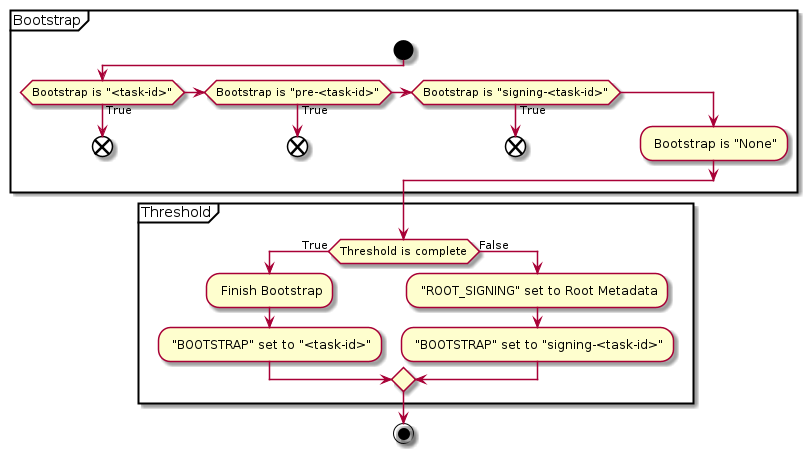
Bootstrap
if the included root has enough signatures, task is finalized right away
otherwise, task is put in pending state and half-signed root is cached (RSTUF Setting:
ROOT_SIGNING)
Note
See BOOTSTRAP and ROOT_SIGNING states reference in
Architecture Design: TUF Repository Settings.
Adding/Removing artifacts
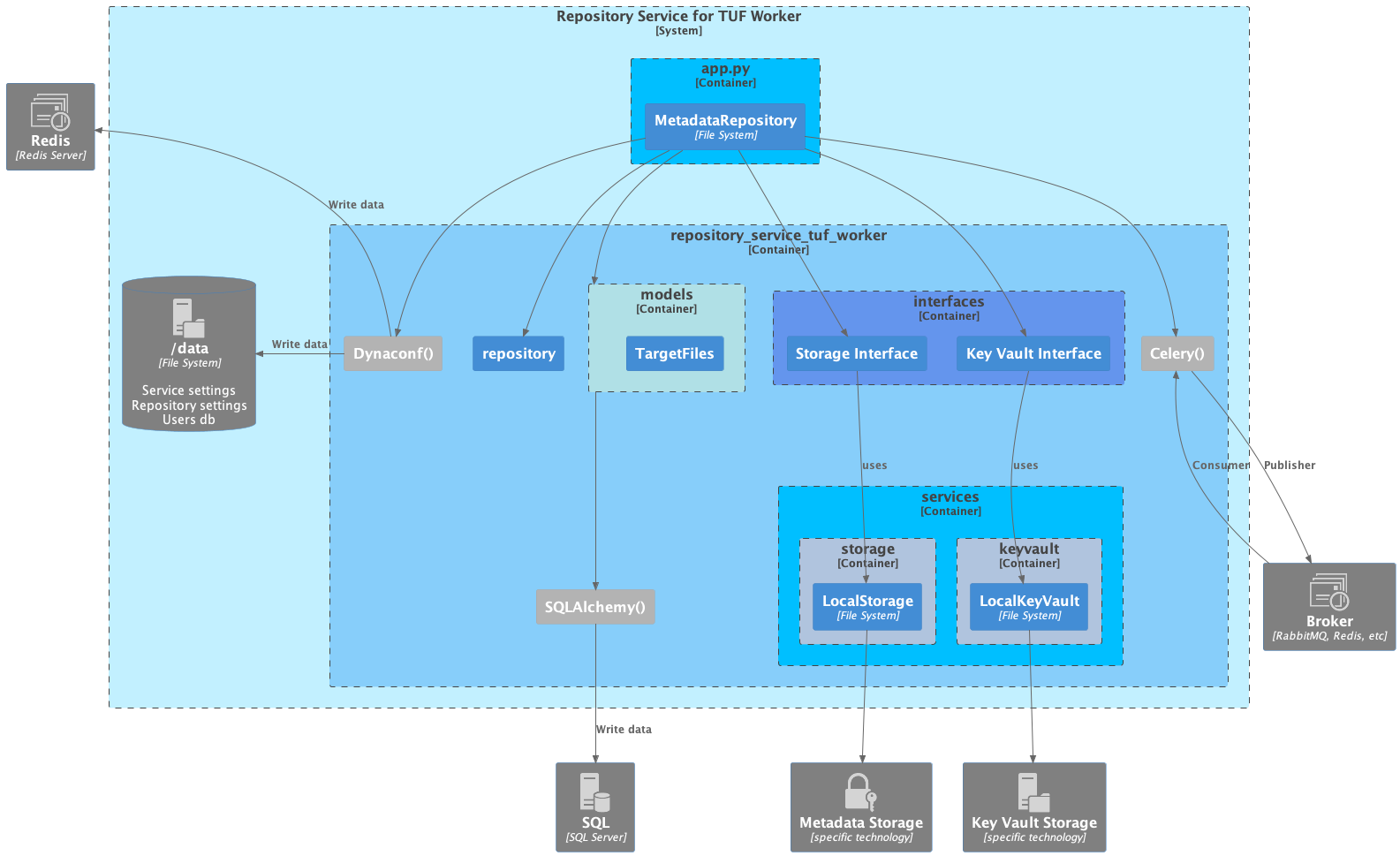
As mentioned at the container level, the domain of repository-service-tuf-worker
(Repository Worker) is managing the TUF Repository Metadata.
The Repository Worker has an Metadata Repository (MetadataRepository) implementation
using python-tuf.
The repository implementation has different methods such as adding new artifacts, removing artifacts, bumping role metadata versions (ex: Snapshot and Timestamp), etc.
The Repository Worker handles everything as a task. To handle the tasks, the Repository Worker uses Celery as Task Manager.
We have two types of tasks:
First are tasks that Repository Work consumes from the Broker Server are tasks published by the Repository Service for TUF API in the
repository_metadataqueue, sent by an API User.Second are tasks that Repository Work generates in the queue
rstuf_internals. Those are internal tasks for the Repository Worker maintenance.
The tasks are defined in the repository-service-tuf-worker/app.py`, and uses Celery
Beat as
scheduler.
The repository Worker has two maintenance tasks:
Bump Roles that contain online keys (“Snapshot”, “Timestamp” and Hahsed Bins (“bins-XX”).
Publish the new Hashed Bins Target Roles (“bins-XX”) with new/removed artifacts.
About Bump Roles (bump_online_roles) that contain online keys is easy.
These roles have short expiration (defined during repository configuration) and
must be “bumped” frequently. The implementation in the RepositoryMetadata
Publish the new Hashed Bins Target Roles (publish_artifacts)
To understand more, every time the API sends a task to add a new artifact(s), the Hashed Bins Roles must be changed to add the new artifact(s), followed by a new Snapshot and Timestamp versions.
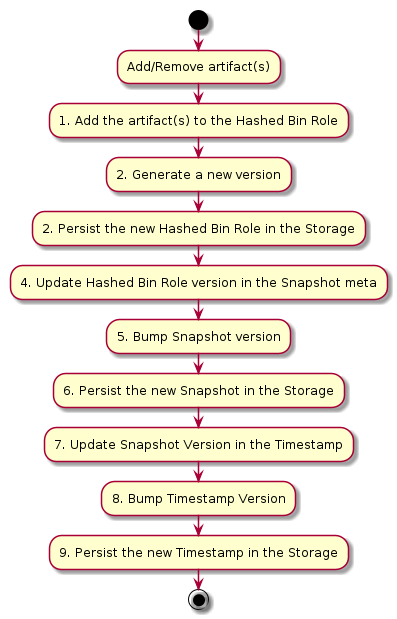
To give more flexibility to multiple Repository Workers to handle multiple tasks and not wait until the entiry flow is done, per each task, we split it.
We use the ‘waiting time’ to alternate between tasks.
Note
This is valid flow for the Repository Metadata Methods add_artifacts and remove_artifacts
Repository Worker adds/removes the artifact(s) to the SQL Database.
It means the multiple Repository Workers can write multiple artifacts
(TargetFiles) simultaneously from various tasks in the Database.
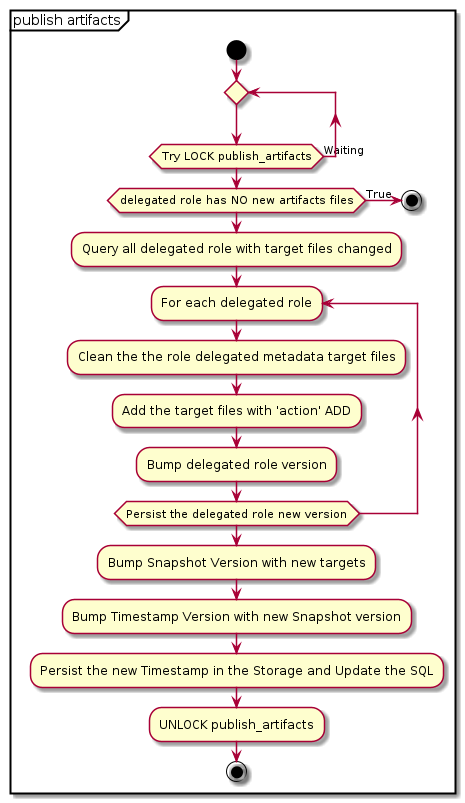
The Publish the new Hashed Bins Target Roles is a synchronization between the SQL Database and the Hashed Bins Target Roles in the Backend Storage (i.e. JSON files in the filestytem)
When a task finishes, it sends a task the Publish the new Hashed Bins Target Roles .
Every minute, the routine task Publish the new Hashed Bins Target Roles also runs.
The task will continue running and waiting until all the artifacts are persisted to the Repository Metadata backend.
The Publish the new Hashed Bins Target Roles task runs once per time to using locks [1] . It will will do:
RSTUF Worker Backend Services Development
Storage
LocalStorage
The default RSTUF Worker source code is configured to use LocalStorage.
Initiate the local development environment
make run-dev
AWSS3
Initiate the aws development environment
make run-dev DC=aws